SEO Text Analyzer and Uniqueness Check
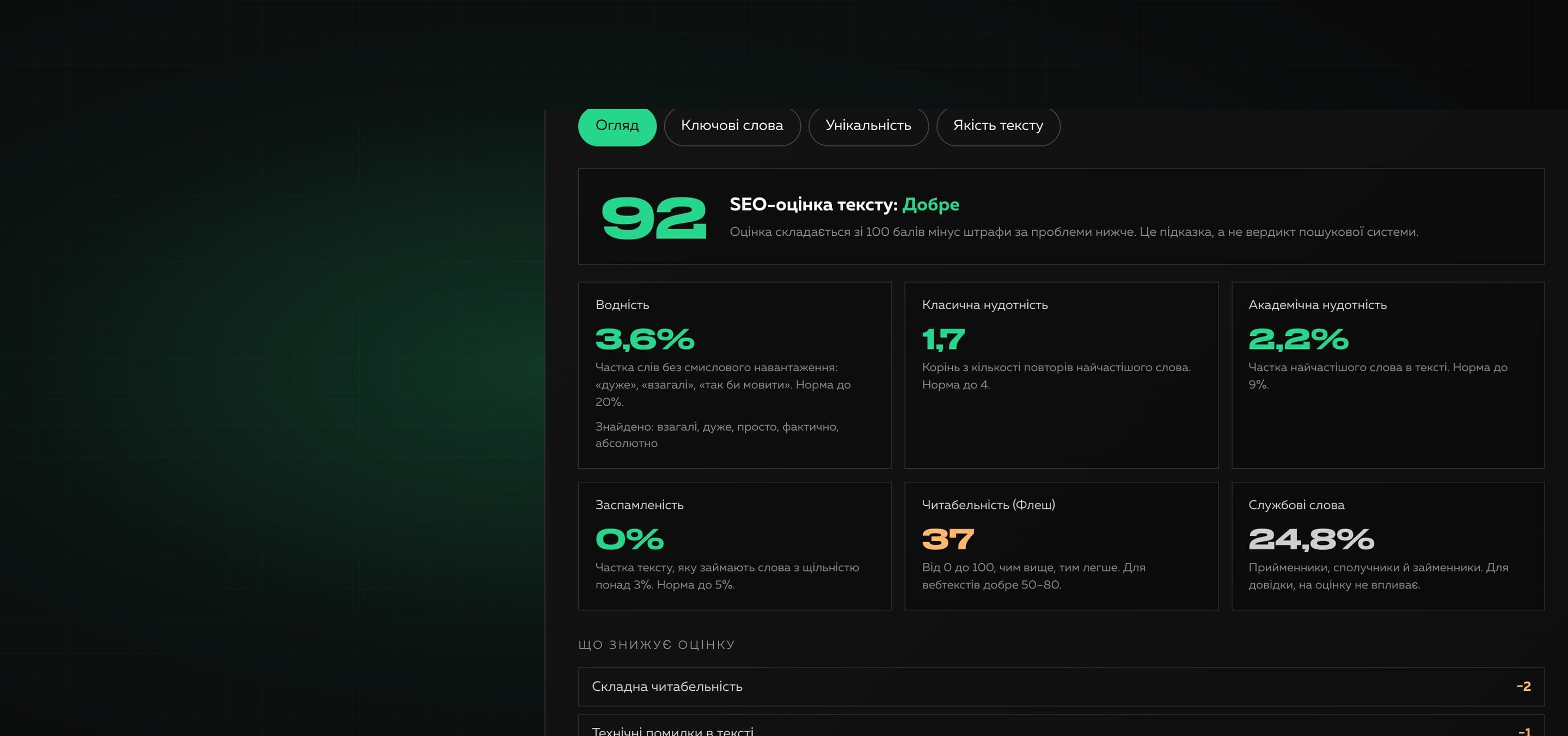
SEO Text Analyzer and Uniqueness Check is a Creomatix product for editors and SEO specialists. It calculates the indicators familiar from text.ru, compares a text with other texts with highlighted matches, looks for repeats and, when a search API is available, checks fragments on the web. The main checks run in the browser, so the text is sent nowhere. You can try it on the “SEO Text Analyzer and Uniqueness Check” page, and we explain what to check before publishing in the blog.
What was done?
The source was a mockup of a service with a user account, and the first check showed that the analysis in it was entirely simulated. The uniqueness percentage was calculated from a hash of the text, and the “sources of matches” were invented: addresses on real sites (news, academic, BBC) were put together from a list of domains and the start of the first sentence. For two test texts (“lorem ipsum” and a specific car news piece) the answers were hard-coded. Water, keyword stuffing, readability and the SEO score also came from the hash: the same number for the same text but no relation to its content. The Ukrainian stop words were written in Latin letters (“na”, “shcho”), so they did not work at all. In addition, sentence splitting broke on abbreviations and decimals, DOCX files were advertised but read as plain text, limits were not checked, the results page showed the same invented data every time, and the search volume, CPC and competition of keywords had no source. The account (sign in, sign up, history, projects, pricing, PDF export) was a set of mockups without a backend.
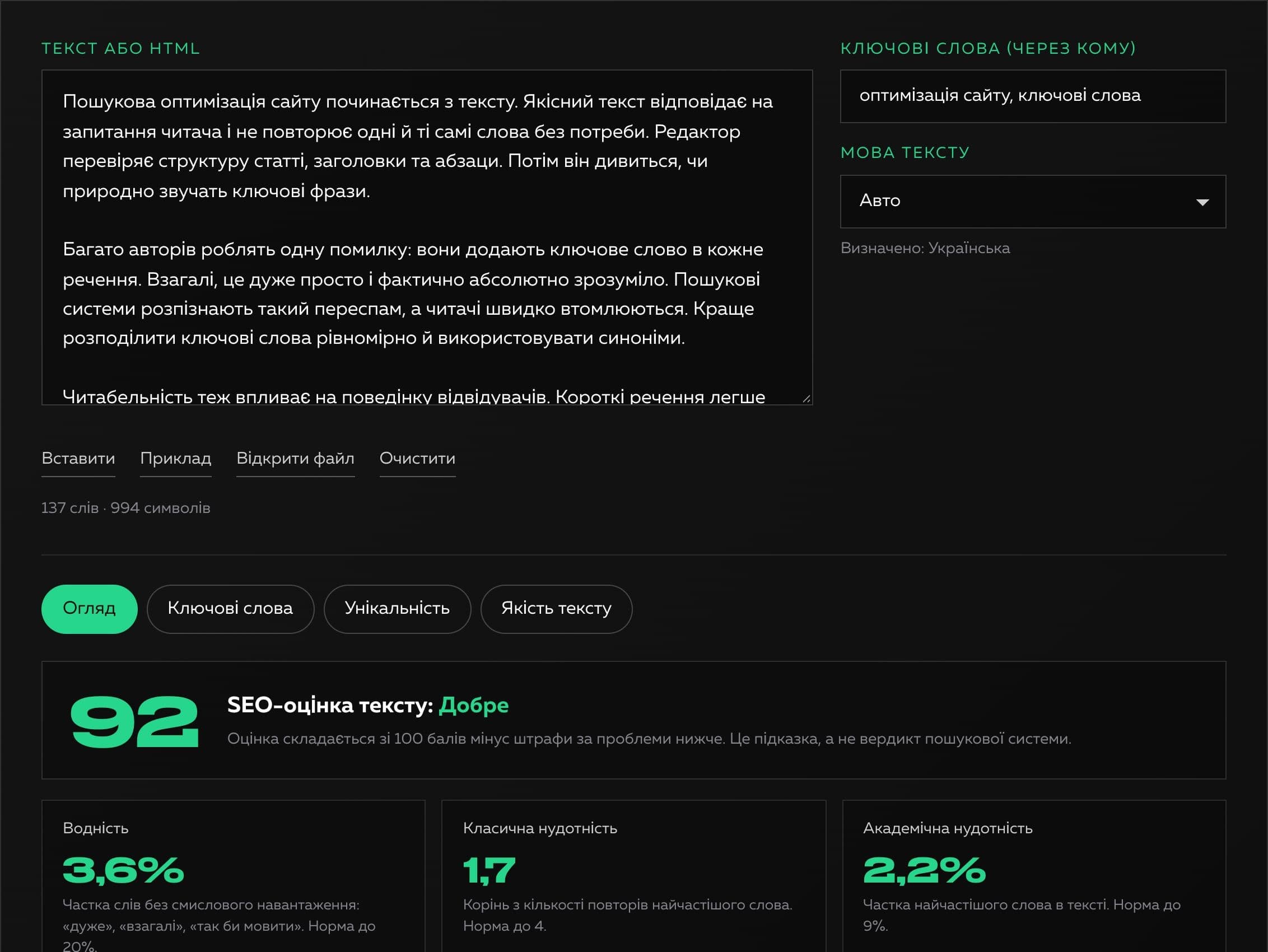
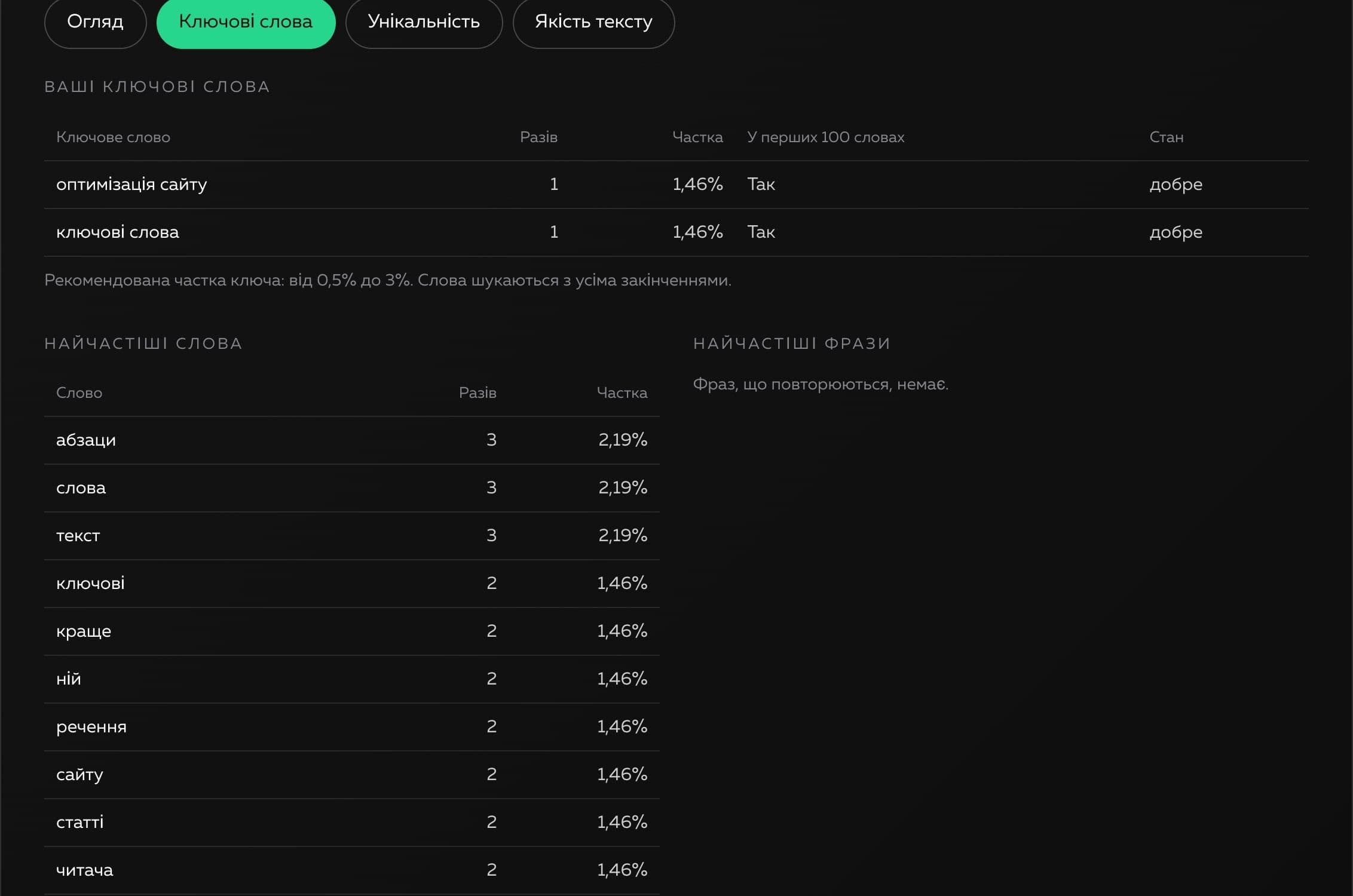
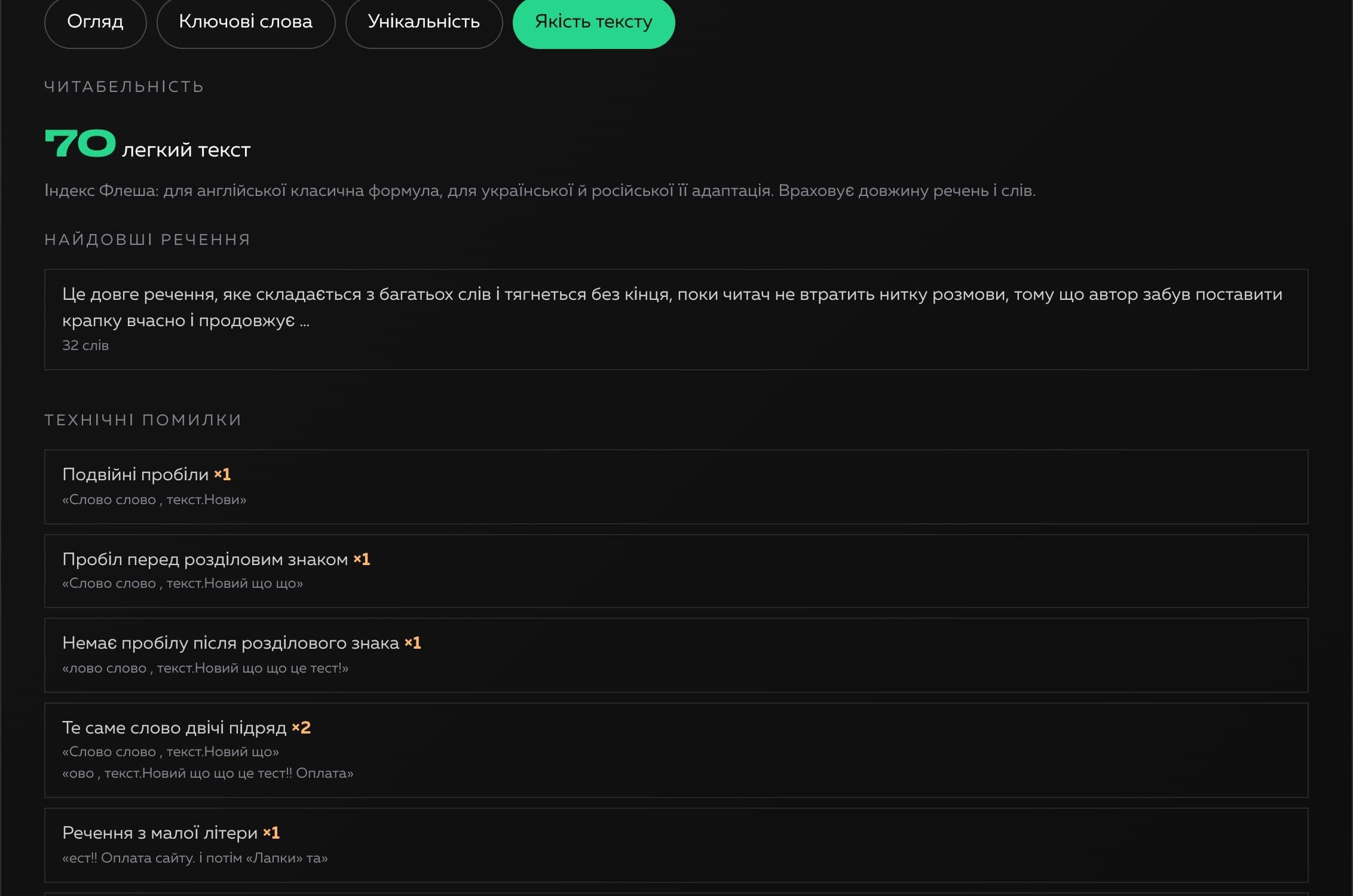
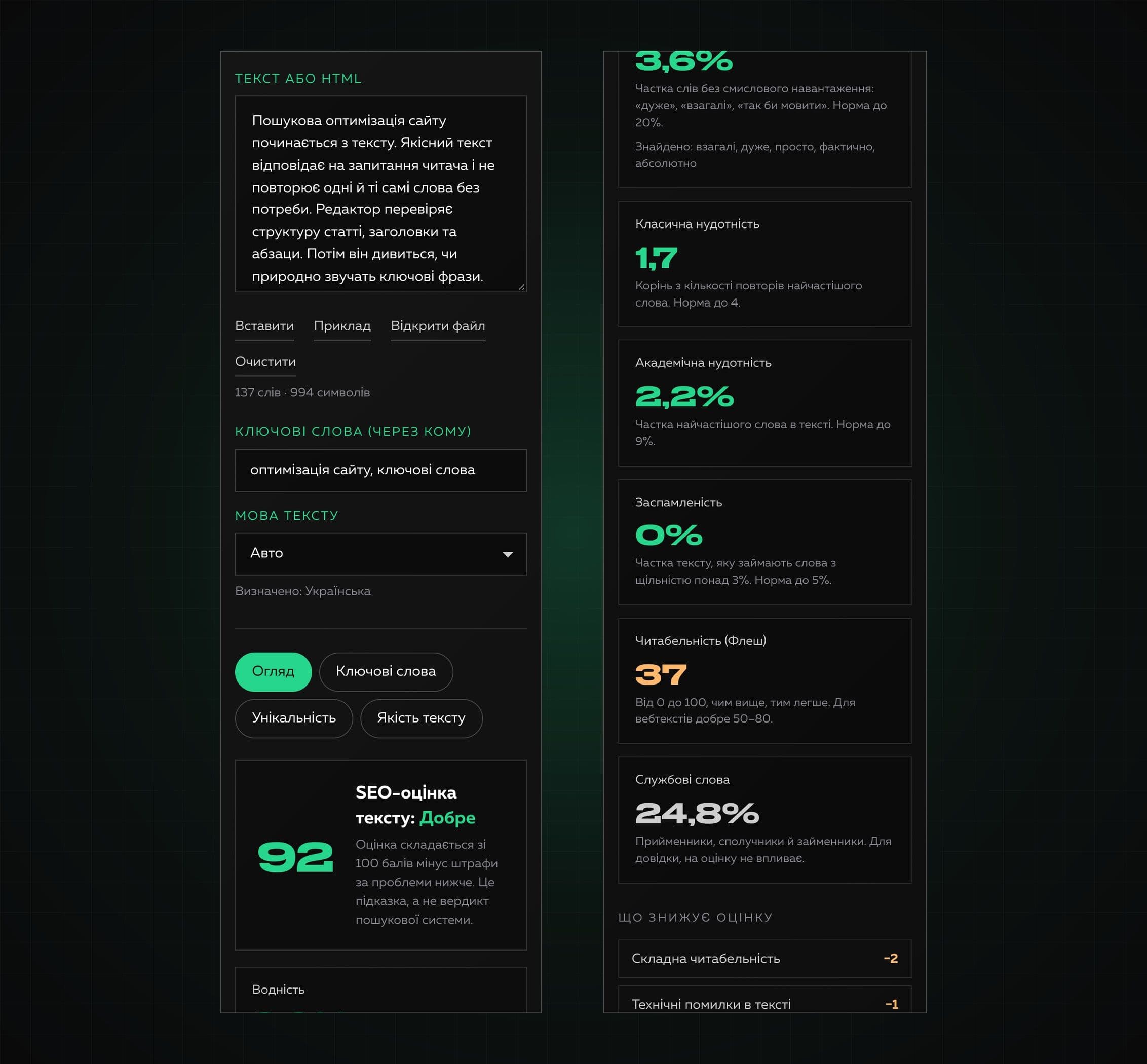
We wrote real logic. The indicators are calculated by transparent formulas: water as the share of words and phrases with no meaning, classic nausea as the square root of the repeats of the most frequent word, academic nausea as its share, keyword stuffing as the share of the text with words over 3% density, and Flesch readability (adapted for Ukrainian and Russian). Words are grouped by a stemmer so that “оптимізація”, “оптимізації” and “оптимізацією” count as one word. There are keywords and phrases, a check of your own keywords (count, density, presence at the start), technical mistakes (double spaces, a space before a comma, a repeated word, a Latin letter inside a Cyrillic word, mixed quotes) and an overall score that breaks down into penalties.
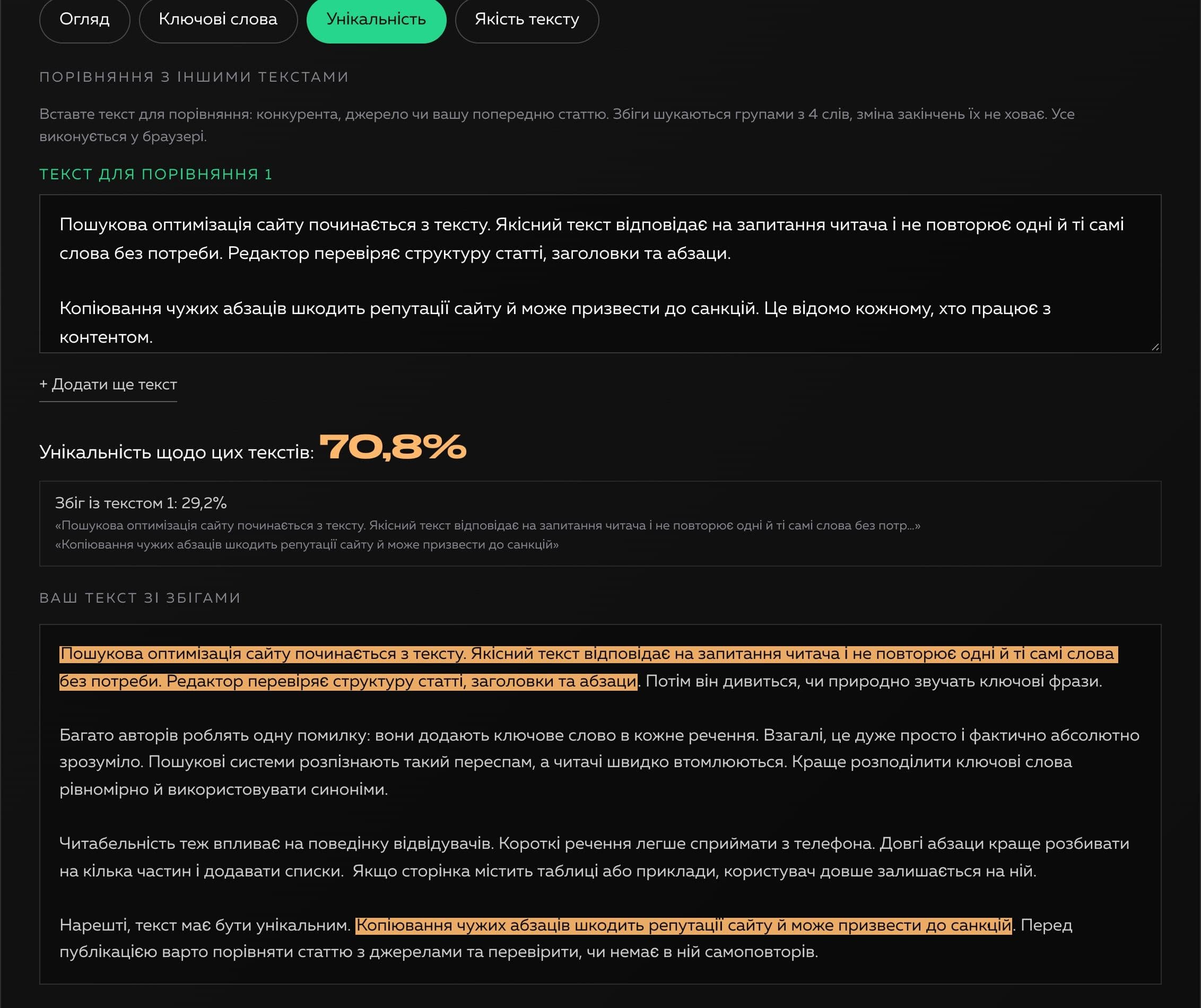
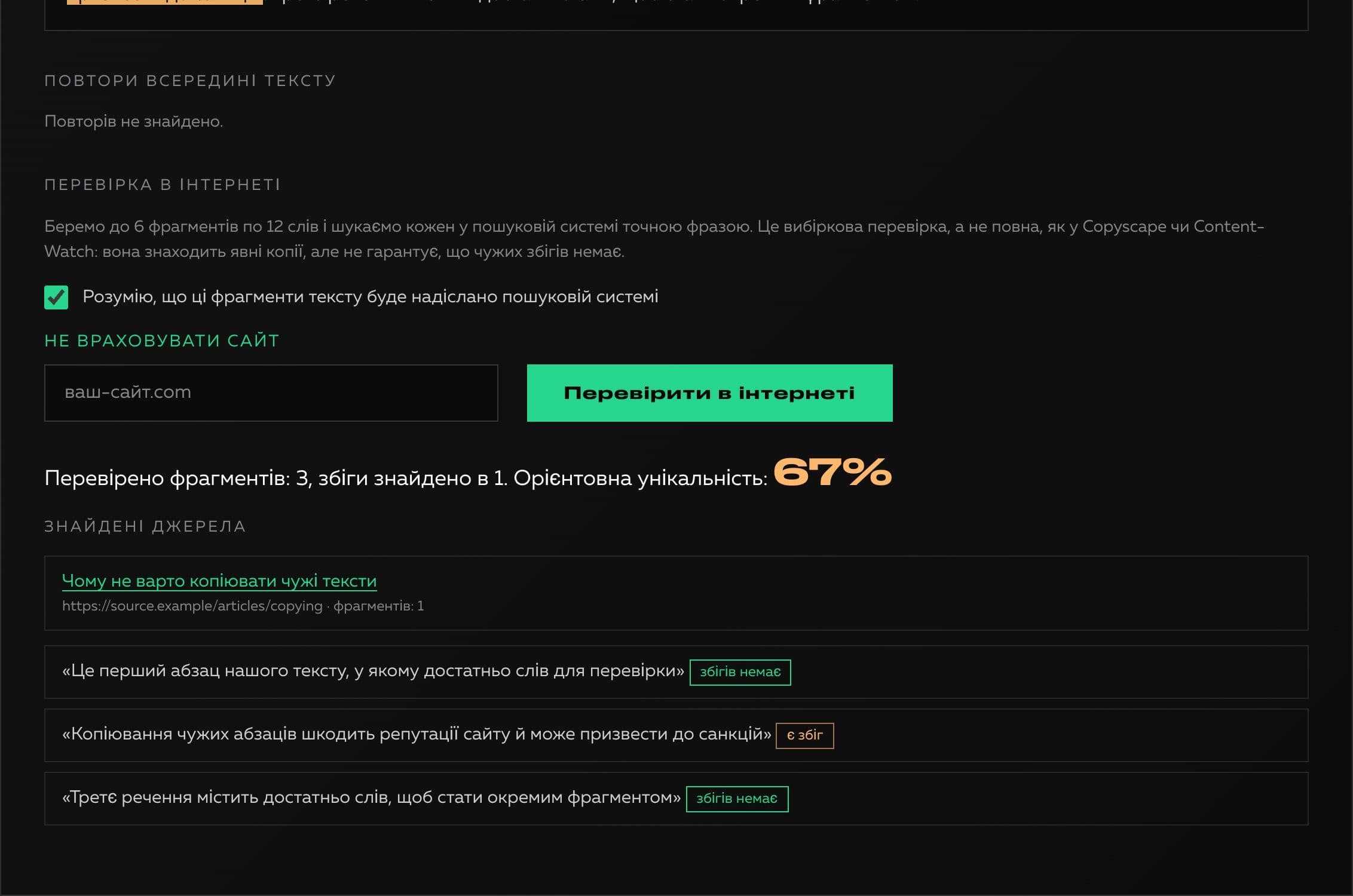
Uniqueness is checked honestly. Always available are comparison with your own texts by groups of words with word endings taken into account, with highlighted matches, and a search for repeats inside the text. The web check is separate and is a sample: a server route takes up to six fragments of 12 words and searches them as exact phrases through a search API (Brave or Google). It turns on only when a key is set in the server settings, needs the user’s consent, checks the origin of the request and limits the rate. The key never reaches the browser, and a match is confirmed only if the returned description really contains the fragment. The interface says plainly that this is not a full database like Copyscape or Content-Watch.
The interface was fully redesigned to match the Creomatix site. We ran 92 logic checks on Ukrainian and English texts, 67 end-to-end checks in Chrome (including the route and a simulated search API: the key in a header, a quoted phrase, rejection of foreign origins, limits) and the mobile version. Analyzing a 330 KB text takes about half a second. Note that we did not test it against live Brave or Google because that needs a key.
Technologies
- Next.js (Pages Router, API route)
- React
- TypeScript
- SCSS Modules
- Own tokenizer, stemmer and shingling
- Brave Search API and Google Programmable Search
- Strapi (product page content)
What we built
- Water, classic and academic nausea, keyword stuffing, Flesch readability
- The most frequent words and phrases with stemming, a check of your own keywords
- Ukrainian, Russian and English with auto detection
- An overall SEO score that breaks down into visible penalties
- Technical mistakes: spaces, repeated words, mixed alphabets, quotes, sentences starting in lowercase
- Comparison with up to five other texts with highlighted matches
- A search for repeats inside the text
- A sample web check through the Brave or Google API, with separate user consent
- A protected route: origin check, limits, no key in the browser, nothing stored
- Input as text, HTML code or .txt and .html files
- Interface versions in Ukrainian and English
What the client got
As a result there is a tool that shows explainable indicators instead of invented numbers, compares texts and honestly says what was actually checked. It works without signing up and mostly in the browser and became the seventh product in the “Products” section of our site.