SEO and websites · Free
SEO URL Generator
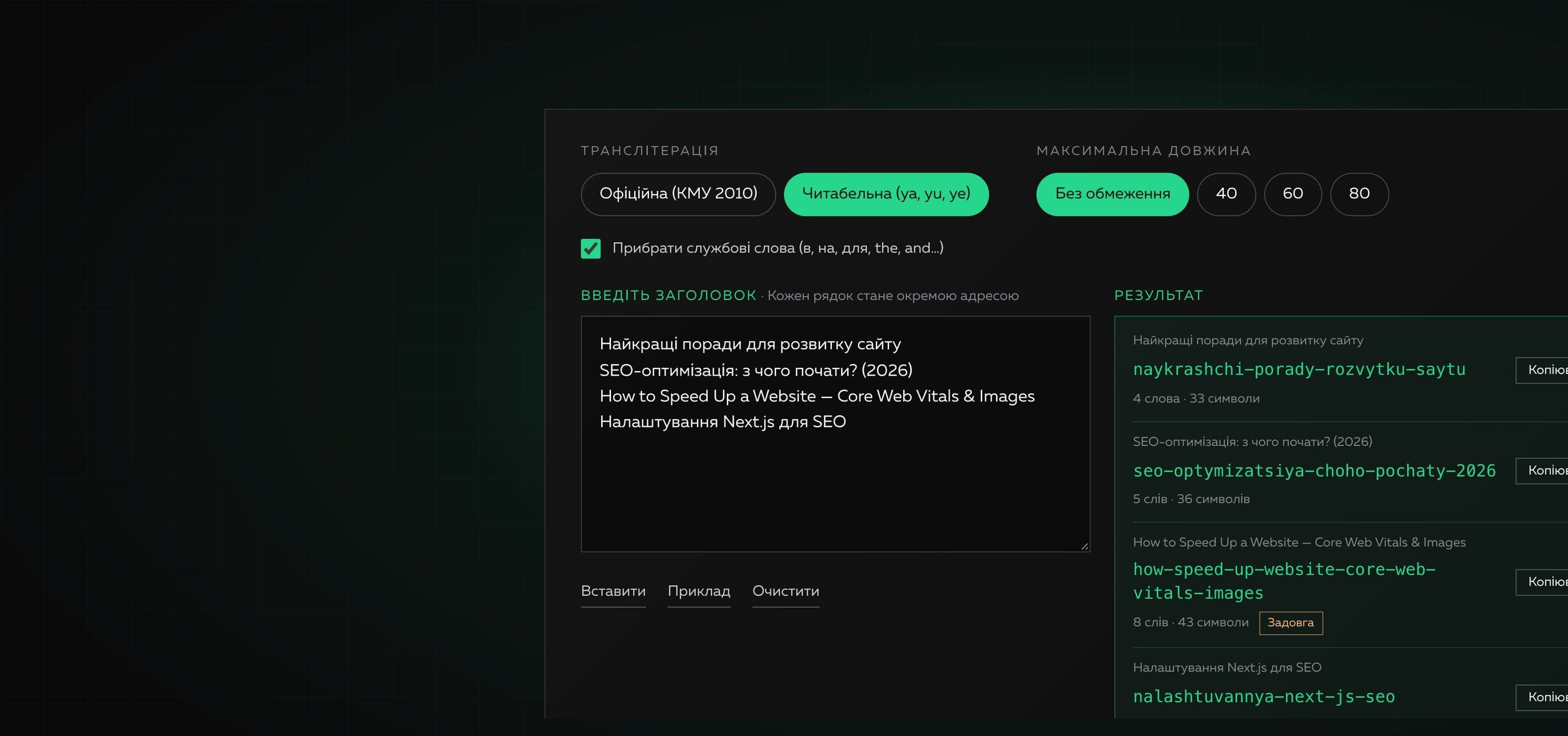
A free online generator of page addresses (slugs) from Ukrainian and English text. Paste a headline, get a clean Latin URL and copy it: everything happens in your browser.
Transliteration
Maximum length
Result
The URL will appear here: just start typing.
Guideline: up to 5 words and 75 characters.
A human-readable URL helps both visitors and search engines understand what a page is about before opening it. Addresses in Cyrillic work, but in messengers, emails and social networks they turn into long percent-encoded strings, so a Latin slug is more convenient and reliable.
The generator turns a headline into a ready address: it transliterates Ukrainian letters by the official standard, keeps Latin words and digits as they are, removes stray punctuation and separates words with a single hyphen. You can enter several headlines at once: each line becomes its own address.
Why it is useful
- 01
Ukrainian and English in one field
Works with Ukrainian, English and mixed headlines, for example “Setting up Next.js for SEO”.
- 02
Official transliteration
The 2010 Ukrainian state standard with its start-of-word rules and “зг” → “zgh”, plus a readable variant with ya, yu, ye.
- 03
Clean addresses without mistakes
No double hyphens, stray characters or merged words: punctuation, dashes and underscores separate words.
- 04
Bulk mode
Paste a list of headlines and get a list of addresses. Duplicate addresses are highlighted.
- 05
Length control
Remove filler words, limit the length and see whether an address fits the guideline of 5 words and 75 characters.
How to use it
- 01
Paste your headlines
Type or paste text. Each line becomes a separate address.
- 02
Choose settings
Pick a transliteration variant and, if needed, remove filler words or limit the length.
- 03
Copy the address
Copy a single address with the button next to it, or all of them at once.
Where it helps
A new article or page
Get a neat address before publishing without inventing one by hand.
Product and category catalogs
Create addresses in bulk for a list of names in bulk mode.
An English version of a site
English headlines with diacritics are handled just as well (“café” → “cafe”).
Site migration and redesign
Prepare new addresses on paper and do not forget redirects from the old ones.
File names
Latin names for images, PDFs and documents without spaces or special characters.
How we built it
Read on the blog
Frequently asked questions
How is the official transliteration different from the readable one?
In the official one (Ukraine, 2010) the letters є, ї, й, ю, я give ye, yi, y, yu, ya at the start of a word and ie, i, i, iu, ia inside it. In the readable one я, ю, є, й always give ya, yu, ye, y. For example “Марія” becomes “mariia” or “mariya”.
Does the page address affect search rankings?
It is a minor signal: content and page quality matter most. But a clear address helps users, makes links neater and simplifies analytics.
Can I keep Cyrillic in addresses?
Technically yes, and search engines support it. But when copied, Cyrillic addresses often turn into long percent-encoded strings, so Latin slugs are more convenient and reliable.
How many words should an address have?
There is no strict rule. In practice, addresses of 3–5 words are easy to read and remember, so the tool highlights overly long ones.
What if I change the address of an already published page?
Set up a permanent (301) redirect from the old address to the new one and update internal links and the sitemap so you do not lose traffic.
Are my headlines stored?
No. Addresses are created in your browser: the text is not sent to a server and not stored anywhere. The tool is free and needs no sign-up.
Need your own tool for your team?
We build useful online tools and internal services: from idea and design to launch. Tell us what routine is worth removing.